

.jpg)
Transform your CRM from a data liability into a strategic asset with AI-powered automation that cleanses, enriches, and maintains customer information in real-time.
The Hidden Cost of Dirty CRM Data
Poor data quality in your CRM system isn't just an inconvenience—it's a silent profit killer that undermines every business decision. When marketing directors launch campaigns based on incorrect contact information, sales teams chase outdated leads, and executives make strategic decisions using flawed analytics, the cumulative impact can be devastating. Studies consistently show that organizations lose an average of 12% of their revenue due to poor data quality, with some estimates suggesting that dirty data costs businesses £15 million annually in the UK alone.
The repercussions extend far beyond missed opportunities. Duplicate records create confusion across teams, leading to embarrassing situations where customers receive multiple conflicting communications or are contacted by different sales representatives about the same opportunity. Incomplete customer profiles prevent personalization efforts, forcing your marketing team to resort to generic messaging that fails to resonate. Outdated information means your sales team wastes valuable time pursuing leads that have changed companies, moved roles, or are no longer in the market.
Perhaps most concerning is how dirty data compounds over time. Without systematic cleansing processes, your CRM deteriorates exponentially as new records enter the system, existing contacts change details, and manual data entry introduces human error. This creates a vicious cycle where teams lose trust in the CRM, begin maintaining separate spreadsheets, and inadvertently create more data silos. The result? Your CRM transforms from a strategic asset into a liability that actively hinders growth rather than enabling it.
How AI-Powered Data Cleansing Transforms CRM Accuracy
Artificial intelligence fundamentally changes the data cleansing paradigm by automating processes that previously required countless hours of manual effort. AI-powered solutions utilise machine learning algorithms to identify patterns, detect anomalies, and recognise data quality issues at scale. These systems can process thousands of records in minutes, flagging duplicates with sophisticated matching logic that goes beyond simple field comparisons to understand contextual relationships and probabilistic matches.
Modern AI cleansing tools employ natural language processing to standardise data formats automatically. They can recognize that 'St.', 'Street', and 'Str' all represent the same address component, or that 'CEO', 'Chief Executive Officer', and 'Managing Director' might refer to similar roles depending on company size and region. This intelligent normalization ensures consistency across your database without requiring rigid data entry protocols that slow down user adoption. The technology also validates data against authoritative external sources, automatically correcting phone number formats, postal codes, and company names to match official registries.
What makes AI-powered cleansing particularly valuable is its ability to learn and improve continuously. As the system processes more data and receives feedback on its recommendations, the algorithms become increasingly accurate at identifying issues specific to your industry and data patterns. This adaptive learning means the solution becomes more effective over time, automatically adjusting to new data quality challenges as your business evolves. Advanced implementations can even predict data decay, proactively flagging records that are likely to become outdated based on typical industry patterns and previous data lifecycle behaviors.
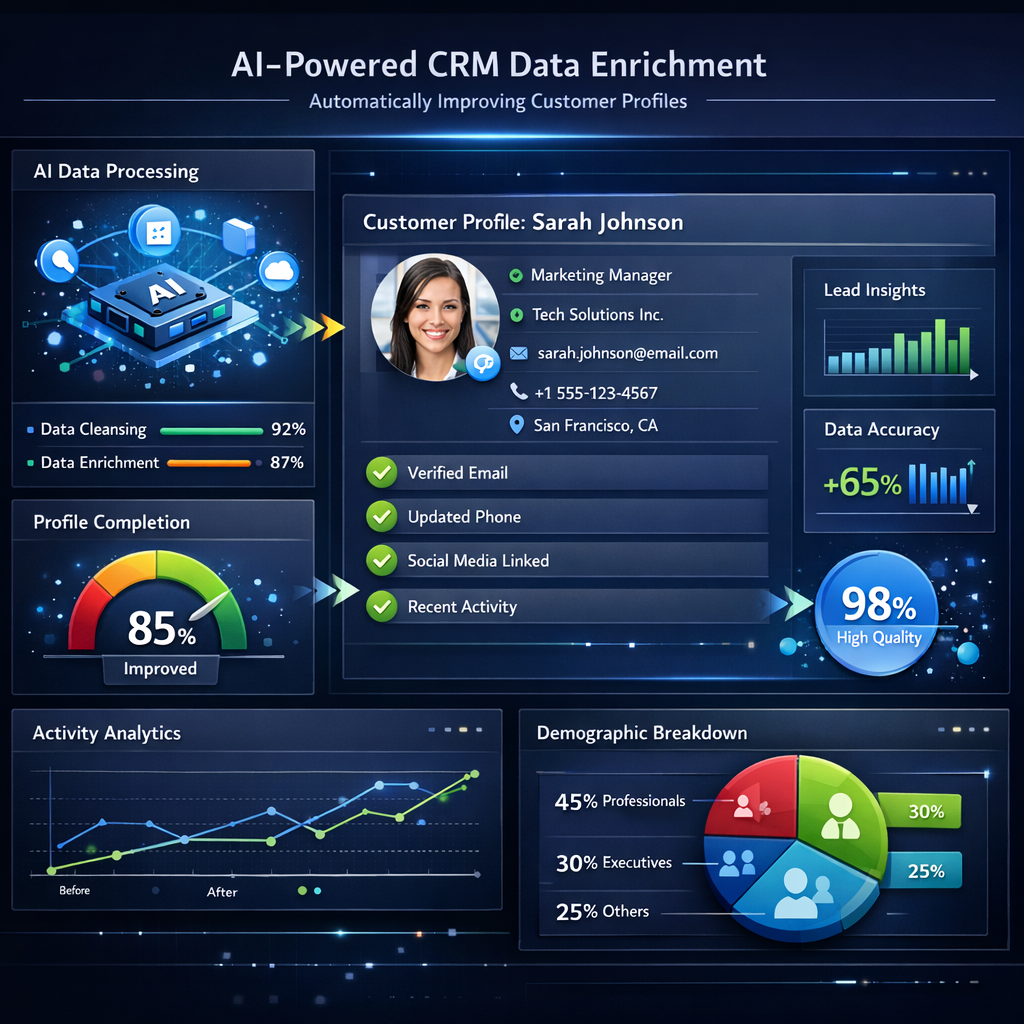
The automation doesn't just save time—it fundamentally transforms data governance from a periodic cleanup project into an ongoing maintenance process. Rather than scheduling quarterly data scrubbing sessions that disrupt team productivity, AI solutions work continuously in the background, maintaining data quality in real-time. This approach prevents the accumulation of data debt and ensures that every team interaction with the CRM is based on accurate, reliable information that builds confidence rather than eroding trust.
Automated Data Enrichment: Building Complete Customer Profiles
While cleansing addresses data accuracy, enrichment focuses on completeness—filling the gaps that prevent you from truly understanding your customers. AI-powered enrichment solutions automatically append missing information to existing records by cross-referencing multiple authoritative data sources. This includes firmographic data such as company size, revenue, industry classification, and technology stack, as well as individual contact details like professional background, social media profiles, and organizational hierarchy.
The intelligence lies in how these systems prioritize and validate enrichment data. Rather than blindly appending information, sophisticated AI solutions assess the reliability of different data sources, cross-reference multiple providers, and assign confidence scores to enriched fields. This ensures that your team can trust the added information and understand when additional verification might be warranted. The technology also respects data privacy regulations, enriching records only with publicly available information and maintaining full audit trails for compliance purposes.
Behavioral enrichment represents the next frontier in customer understanding. AI systems analyse interaction patterns across email engagement, website visits, content downloads, and support conversations to build comprehensive behavioral profiles. These insights reveal customer intent, identify buying signals, and segment contacts based on actual engagement rather than static demographic criteria. When combined with predictive analytics, enriched profiles enable sales teams to prioritize high-potential opportunities and marketing teams to deliver precisely targeted campaigns that resonate with specific customer segments.
The true power emerges when enrichment becomes an automated, ongoing process rather than a one-time data append project. As contacts interact with your business and publicly available information updates, AI solutions continuously refresh and enhance profiles without manual intervention. This living, breathing database provides a 360-degree view of each customer that evolves in real-time, enabling your teams to engage with context and relevance at every touchpoint. The result is a CRM that doesn't just store information but actively generates strategic insights that drive business growth.
Implementing AI Solutions Within Your Existing CRM Infrastructure
Successfully implementing AI-powered data cleansing and enrichment requires careful integration with your existing CRM infrastructure rather than wholesale system replacement. Modern AI solutions are designed to work alongside platforms like HubSpot, Salesforce, and Microsoft Dynamics through robust API connections and native integrations. This approach preserves your existing workflows, maintains user familiarity, and protects the investment you've already made in CRM customization and configuration.
The implementation process typically begins with a comprehensive data audit to establish baseline quality metrics and identify specific data issues affecting your organization. This diagnostic phase reveals patterns in data decay, highlights fields with the highest error rates, and prioritizes cleansing efforts based on business impact. Understanding your current data landscape allows you to configure AI rules and thresholds that align with your specific data governance policies and operational requirements. For instance, you might set stricter matching criteria for duplicate detection in certain record types while allowing more flexible matching for others.
Integration architecture matters significantly for long-term success. The most effective implementations establish bidirectional data flows where the AI solution can both read existing CRM data and write back cleansed, enriched information while maintaining proper field mapping and respecting existing validation rules. Middleware platforms and integration tools enable sophisticated workflows where data cleansing occurs automatically during record creation, enrichment triggers based on lifecycle stage changes, and validation checkpoints prevent poor-quality data from entering the system in the first place.
Change management represents the often-overlooked critical success factor. Even the most sophisticated AI solution will fail if your teams don't understand how to leverage cleaner data or continue maintaining separate systems because they don't trust the CRM. Successful implementations include comprehensive training that demonstrates the immediate benefits of improved data quality, establishes clear protocols for handling AI recommendations, and creates feedback loops where users can flag issues and contribute to algorithm refinement. Building this organizational commitment to data quality ensures that AI cleansing and enrichment becomes an enabler of business transformation rather than just another technology implementation.
Measuring Success: ROI and Performance Metrics for Data Quality
Quantifying the return on investment from AI-powered data quality initiatives requires establishing clear metrics that connect data improvements to business outcomes. Start by measuring direct data quality indicators: percentage of duplicate records, completeness rates across critical fields, data accuracy scores validated against external sources, and the average time for data decay. These foundational metrics provide objective evidence of improvement and help justify the ongoing investment in data quality tools and processes.
The more compelling ROI story emerges when you connect data quality improvements to operational efficiency gains. Track metrics such as time saved on manual data cleansing tasks, reduction in bounced emails and returned mail, decrease in wasted sales follow-up efforts on outdated leads, and improved campaign targeting accuracy. When your marketing team can segment audiences with confidence and your sales team spends time on legitimate opportunities rather than chasing ghost contacts, the productivity gains translate directly to cost savings and revenue generation.
Revenue impact metrics provide the most persuasive business case for data quality investment. Monitor how improved data quality affects conversion rates at each stage of your sales funnel, average deal size influenced by better customer understanding, customer retention rates enabled by more personalized engagement, and the effectiveness of upsell and cross-sell initiatives guided by complete customer profiles. Organizations that implement comprehensive data quality programs typically see 15-25% improvements in campaign response rates and 10-20% increases in sales productivity within the first year.
Establish a continuous measurement framework that tracks data quality as an ongoing operational metric rather than a one-time project outcome. Create executive dashboards that visualize data health indicators alongside other key performance indicators, implement automated alerts when data quality drops below acceptable thresholds, and schedule regular reviews that assess how data quality initiatives contribute to strategic business objectives. This approach embeds data quality into your organizational culture, ensuring that the gains from AI-powered cleansing and enrichment compound over time rather than gradually deteriorating back to previous states. When data quality becomes a visible, measured priority, it transforms from a technical concern into a strategic competitive advantage that enables every aspect of your business operations.