Selecting the right CRM software can transform your customer relationships, streamline operations, and accelerate growth—but with dozens of options available, how do British businesses make the choice that aligns with their unique needs?
Understanding Your Business Requirements Before Comparing CRM Solutions
Before diving into feature comparisons and pricing tiers, UK businesses must first undertake a thorough assessment of their unique requirements. The right CRM isn't necessarily the most feature-rich or the most affordable—it's the solution that aligns with your specific business processes, team structure, and growth trajectory. This foundational step prevents the common pitfall of investing in software that looks impressive on paper but fails to deliver practical value in day-to-day operations.
Begin by mapping your current customer journey from initial contact through to post-sale support. Identify where data silos exist, which manual processes consume excessive time, and where customer information falls through the cracks. Speak with team members across sales, marketing, and customer service to understand their pain points. Are your sales teams struggling with lead prioritisation? Does marketing lack visibility into which campaigns drive actual revenue? Is customer data scattered across spreadsheets, emails, and disparate systems causing confusion and friction?
Consider your growth plans alongside your current needs. A CRM that serves a team of five brilliantly may buckle under the demands of 50 users. Conversely, enterprise-grade solutions can overwhelm small teams with unnecessary complexity. Think about integration requirements with your existing tech stack—from accounting software to marketing automation tools—as disconnected systems create the very silos you're trying to eliminate. Wave delivers multiple workshops on this per month, helping UK businesses articulate their requirements before committing to a platform, ensuring the foundation for CRM success is properly established.
Key Features That Matter Most
Not all CRM features deliver equal value, and the most successful implementations focus on capabilities that directly address documented business needs rather than chasing an exhaustive feature list. For UK businesses, certain core functionalities prove consistently valuable: contact management that creates a single source of truth for customer data, pipeline visualisation that enables accurate forecasting, and automation capabilities that eliminate repetitive manual tasks.
HubSpot stands out for its comprehensive approach, offering a unified platform where marketing, sales, and service functions converge. Its free tier provides substantial functionality for growing businesses, whilst paid tiers unlock advanced marketing automation, sophisticated reporting dashboards, and AI-powered insights. The platform excels at creating personalised customer experiences through smart content, chatbots, and workflow automation. For businesses seeking to scale their marketing operations, HubSpot's campaign management tools, A/B testing capabilities, and attribution reporting deliver the data-driven insights needed to optimise return on investment.
Capsule takes a refreshingly straightforward approach, prioritising simplicity and ease of use without sacrificing power. Its clean interface makes adoption seamless, particularly for teams transitioning from spreadsheets or basic contact management systems. Capsule offers robust pipeline management, customisable sales stages, and integration with popular business tools. The platform's tagging system and custom fields provide flexibility to adapt to various business models, whilst its mobile applications ensure teams can access critical information wherever they work. For UK businesses valuing clarity over complexity, Capsule delivers focused functionality that teams actually use rather than features that gather dust.
Other noteworthy contenders include Salesforce, which offers unparalleled customisation and scalability for larger enterprises, Pipedrive with its sales-focused approach and visual pipeline management, and Zoho CRM, which provides excellent value for businesses requiring extensive features at competitive price points. The key is matching feature sets to your documented requirements rather than being dazzled by capabilities you'll never utilise.
Evaluating Integration Capabilities and Technical Requirements
A CRM system rarely operates in isolation—its true power emerges when it becomes the central hub connecting your entire technology ecosystem. Integration capabilities deserve careful scrutiny, as poor connectivity creates the data silos and manual duplication that CRM adoption aims to eliminate. Assess which business-critical applications must connect with your CRM: accounting software like Xero or Sage, email marketing platforms, e-commerce systems, telephony solutions, and industry-specific tools.
HubSpot offers an extensive marketplace with hundreds of native integrations and a robust API for custom connections. Its integration with Google Workspace and Microsoft 365 is particularly seamless, whilst connections to accounting platforms, payment processors, and analytics tools enable comprehensive data synchronisation. However, complex integrations may require technical expertise to implement properly, and some advanced connectivity options are restricted to higher subscription tiers.
Capsule provides thoughtfully curated integrations with popular business tools including G Suite, Mailchimp, Xero, and Zendesk. Whilst the ecosystem is more focused than HubSpot's sprawling marketplace, the integrations available address common UK business requirements effectively. The platform's API enables custom integrations for businesses with specific needs, though this requires development resources or third-party expertise.
Consider the technical demands each platform places on your organisation. Cloud-based solutions like HubSpot and Capsule eliminate server maintenance and ensure automatic updates, but require reliable internet connectivity. Evaluate data residency requirements—particularly important for UK businesses navigating GDPR compliance—and confirm where customer data will be stored and processed. User permissions and access controls matter significantly for businesses with complex organisational structures or external collaborators requiring limited access. Integration challenges can consume significant time and technical resources, so honest assessment of your team's capabilities versus the complexity of required integrations is essential.
Comparing Total Cost of Ownership and ROI Potential
CRM pricing extends well beyond the headline subscription cost, and UK businesses must calculate total cost of ownership to make informed decisions. The complete financial picture includes implementation costs, data migration expenses, training requirements, ongoing customisation, integration development, and the opportunity cost of team time devoted to managing the system.
HubSpot's pricing structure spans from a genuinely useful free tier through to enterprise packages exceeding £3,000 monthly. The free CRM provides substantial value for startups and small businesses, including contact management, deal tracking, and basic reporting. However, businesses seeking marketing automation, advanced analytics, or extensive contact databases will need paid tiers. HubSpot's contact-based pricing model can create budget pressure as databases grow, though portal optimisation can significantly reduce costs. The platform's comprehensive onboarding resources and extensive documentation reduce training expenses, whilst the unified platform eliminates costs associated with connecting disparate marketing and sales tools.
Capsule offers more straightforward pricing beginning around £14 per user monthly for its Professional tier, with transparent per-user costs that scale predictably as teams grow. The absence of contact limits removes a significant variable cost concern, making budgeting more straightforward. Implementation tends to be faster due to the platform's simplicity, reducing both consulting fees and the productivity impact of lengthy deployments. However, businesses may need to budget for additional tools to achieve capabilities that come bundled in more comprehensive platforms and may hit hurdles as they grow.
When evaluating ROI potential, look beyond software costs to the business value generated. CRM systems deliver returns through improved conversion rates, shorter sales cycles, reduced customer churn, and increased efficiency. A CRM that automates previously manual processes might justify higher costs through time savings alone. Marketing attribution capabilities enable better budget allocation, potentially improving campaign ROI substantially. Enhanced customer experience translates to higher lifetime value. Calculate expected returns based on realistic assumptions about adoption rates and process improvements, and remember that benefits often accumulate over time as teams develop proficiency and processes mature. Wave's HubSpot ROI calculator helps businesses evaluate potential returns before committing to investment, ensuring decisions are grounded in projected value rather than feature enthusiasm alone.
Implementation Success: What British Businesses Need to Consider
Selecting the right CRM is merely the first step—successful implementation determines whether that choice delivers promised value or becomes an expensive source of frustration. UK businesses must approach implementation as a change management initiative rather than a purely technical project, as user adoption ultimately determines success or failure.
Begin with clear objectives tied to specific business outcomes rather than vague aspirations to 'improve customer relationships.' Define success metrics before implementation begins: percentage increases in conversion rates, reductions in sales cycle length, improvements in customer retention, or hours saved through automation. These concrete targets guide configuration decisions and provide benchmarks for measuring success.
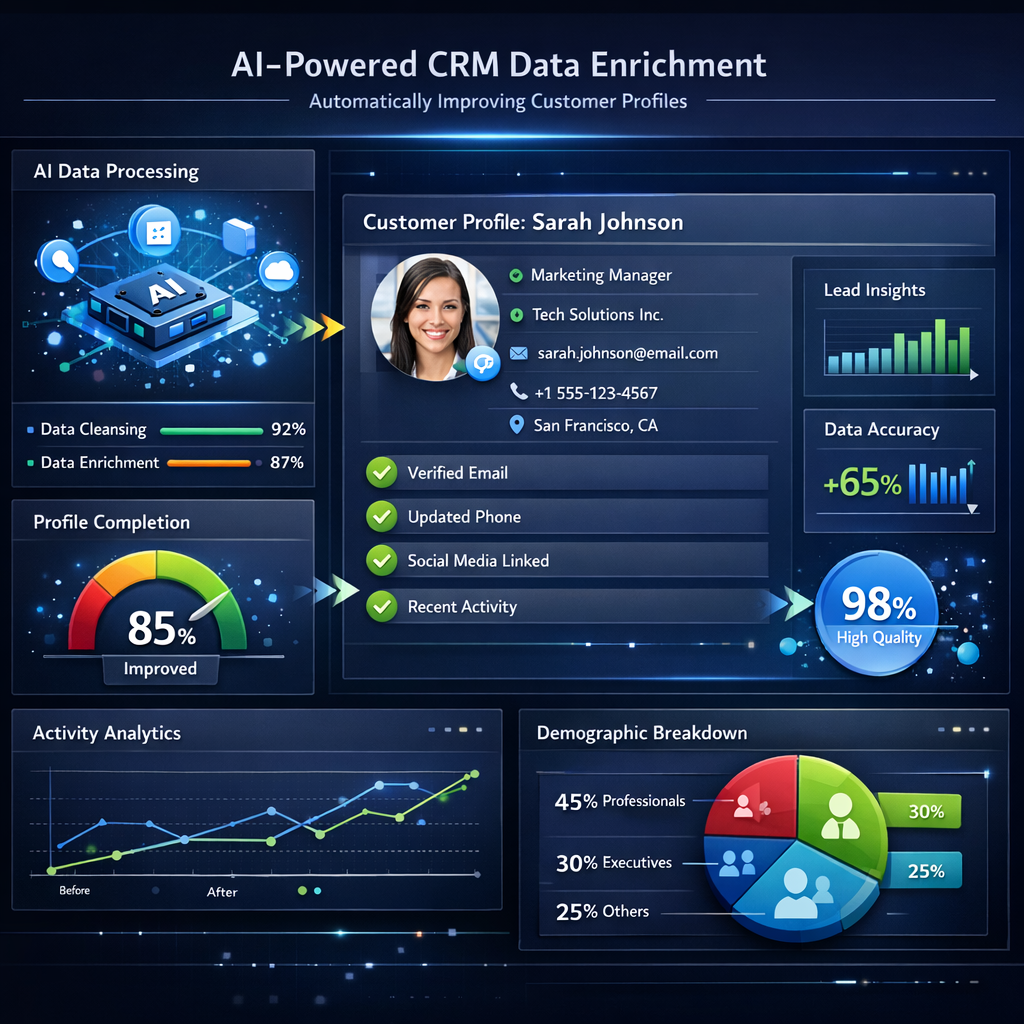
Data migration deserves meticulous attention, as incorrect or incomplete customer data undermines the entire system. Audit existing data sources, identify the single source of truth where conflicts exist, establish data standards, and clean information before migration rather than transferring years of accumulated errors — AI-powered tools can automate much of this cleansing and enrichment process, flagging duplicates, correcting inaccuracies, and filling gaps at scale. Consider phased migration approaches that allow testing and refinement before committing fully. Map existing data fields to the new CRM's structure thoughtfully, as poor mapping creates confusion and reduces data usability.
Training must address different learning styles and experience levels within your team. Hands-on sessions where team members complete actual work tasks prove more effective than passive demonstrations. Create role-specific training that focuses on how each team member will use the system daily rather than exhaustive tours of every feature. Identify CRM champions within each department who can provide peer support and encourage adoption. Wave's approach to HubSpot onboarding emphasises creating genuine value rather than simply ticking boxes, with tailored training sessions addressing specific knowledge gaps and hands-on guidance that gets teams productive quickly.
Establish governance processes from the outset. Define who owns different aspects of the CRM, how changes are requested and approved, and how data quality is maintained over time. Without clear governance, CRM systems deteriorate as users create duplicate records, develop inconsistent processes, and accumulate technical debt that eventually requires expensive remediation. Regular audits identify emerging issues before they become endemic, whilst ongoing training ensures new team members learn proper practices rather than inheriting bad habits from existing users.
The Hidden Cost of Free
Free CRM tiers offer compelling entry points, particularly for startups and small businesses operating with limited budgets. HubSpot's free CRM has introduced thousands of UK businesses to proper customer relationship management, providing capabilities that would have cost thousands of pounds just a few years ago. However, understanding the limitations and potential hidden costs of free tiers prevents unexpected challenges down the line.
Free CRM offerings typically restrict advanced features that become increasingly important as businesses grow. Marketing automation, sophisticated reporting, advanced customisation, API access, and premium support often sit behind paywalls. For businesses with basic needs, these limitations may never constrain operations. However, companies with growth ambitions should evaluate whether free tier restrictions will necessitate migration to paid plans within a foreseeable timeframe, as mid-stream platform changes disrupt operations and require fresh training.
The hidden costs emerge in other forms as well. Limited support options mean teams spend more time troubleshooting issues independently or seeking answers through community forums rather than receiving direct assistance. Integration restrictions may force businesses to maintain manual processes or invest in middleware solutions. Contact limits on some free tiers create perverse incentives to delete valuable historical data or avoid capturing information that would benefit customer relationships.
Free tiers can also create technical debt that becomes expensive to address later. Businesses may develop workarounds for missing features, creating convoluted processes that embed themselves in operations. When eventually upgrading or migrating, these improvised solutions must be unpicked and rebuilt properly. Data accumulated in free systems sometimes proves challenging to extract or migrate, creating unexpected costs when changing platforms.
None of this suggests free CRM tiers lack value—they provide genuine utility for appropriate use cases and remove barriers to proper customer data management. The key is entering with clear-eyed understanding of limitations and realistic assessment of how long free features will suffice. For many UK businesses, free CRMs serve as excellent learning platforms where teams develop proficiency before committing to paid solutions. Others find free tiers meet their needs indefinitely. The crucial element is intentional choice rather than drifting into free options without considering whether modest investment in paid features would deliver disproportionate value. Platforms like Capsule offer affordable paid tiers that may provide better long-term value than stretching free alternatives beyond their intended use cases, whilst HubSpot's structured tier approach allows businesses to upgrade specific hubs as needs develop rather than moving everything simultaneously.